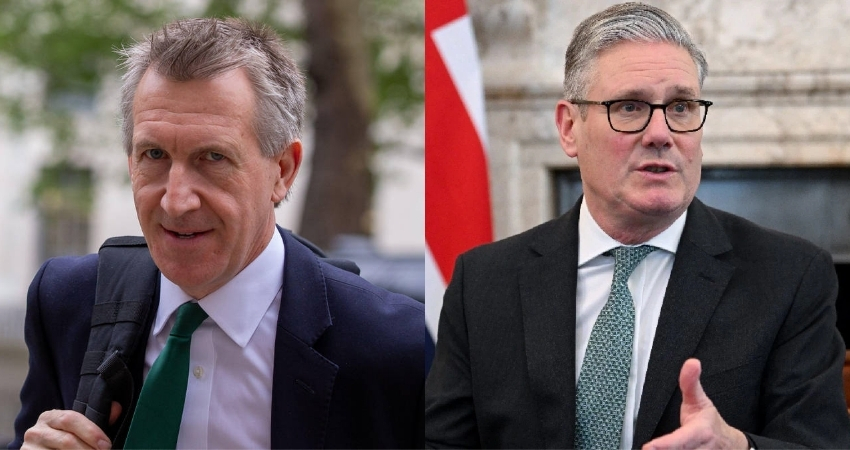
Sir Keir Starmer has been told to “get a grip” on Britain’s defence policy after the “chaos” surrounding the resignations of John Healey and Al Carns.
Speaking to GB News, Shadow Defence Secretary James Cartlidge accused the Prime Minister of trying to shift attention away from the turmoil within Government ranks.
Responding to Labour’s announcement that a Russian oil tanker had been seized in the English Channel, Mr Cartlidge said: “We support this move, although it’s worth noting that many shadow fleet vessels have passed through our waters without any apparent action being taken.
“I welcome the interception of this vessel, though we’re still working with limited information at this stage.”
Praising the efforts of personnel across the Royal Marines, Royal Navy and Royal Air Force, he added: “Our armed forces are full of talented and dedicated people. This operation shows what they can achieve when they have the right equipment and strong leadership behind them.
“I hope this marks the start of a more robust approach under the new Defence Secretary. We need to send a clear message to Russia, but that also means moving beyond the disorder we’ve seen in recent days surrounding the Defence Investment Plan.”
The Shadow Defence Secretary said the Prime Minister must take control of Britain’s defence strategy.
He explained: “For us, that starts with finding the funding. I think most people now recognise that.
“A key part of that is getting welfare spending under control so more resources can be directed towards our armed forces. We need a long-term commitment, not isolated actions, to show our adversaries that Britain is serious about defence once again.”
Mr Cartlidge also criticised Labour’s plans to raise defence spending by just “0.08 per cent by 2030”, arguing it falls far short of what is required.
He said: “I think everyone understands that 0.08 per cent simply isn’t enough. Even John Healey, the former Defence Secretary, recognised that, which is why he stepped down.
“We believe defence spending should reach three per cent during this Parliament, and that a significant part of that should be funded through welfare reforms that strengthen the country’s finances and security.”
GB News host Emily Carver pushed back, pointing to Conservative governments and arguing that Britain’s armed forces had been weakened under Tory rule.
Mr Cartlidge replied: “The Army has been shrinking almost continuously since the Second World War, and in some years the reductions were substantial. That trend has existed under governments of different colours.
“In fact, only two prime ministers since the war left office with an Army larger than when they entered Downing Street — Gordon Brown and Alec Douglas-Home.”
Emily then challenged him further, asking: “So are you admitting the Conservatives got it wrong and were too complacent on defence?”
Mr Cartlidge rejected that claim, telling GB News: “No, not at all. The last time Britain spent three per cent of GDP on defence was in 1996, when the Conservatives were in government, before Tony Blair came to power.
“I’m certainly not complacent. One of the most significant things we did in government was lead support for Ukraine. We took the initiative when others hesitated. Nigel Farage blamed NATO and would not have taken that approach.
“Other countries eventually followed, but Britain showed leadership first, and I’m proud of that.”
He concluded: “Defence spending has declined over the decades because many believed the era of major conflict was behind us. But it’s clear now that those assumptions no longer hold true.”