For most of his life, Ed Bambas believed he had done everything right.

He had served his country as an Army veteran, worked decades at General Motors, and retired in 1999 with the quiet relief of a man who thought he had finally earned a little rest. The house he shared with his wife in Michigan felt warm and safe, and the pension he had spent years contributing to seemed to promise stability.
But life, as Ed would later say in a tired half laugh, “has a way of turning the ground to sand right under your feet.”
When GM went through bankruptcy in 2012, his pension simply vanished. One day he had security. The next, the future he had counted on dissolved. “I kept looking at the papers thinking maybe I misunderstood,” he remembered. “You work hard your whole life, and then, poof.”
The loss of healthcare followed. Then came the hardest chapter of all: caring for his wife through her long illness. He stayed by her side through every appointment, every quiet and difficult night, until she passed away. Afterward, the house that once felt full now echoed with absence. Eventually, Ed sold it. “It felt like saying goodbye twice,” he said softly.
With nearly nothing left, he did the only thing he could. He went back to work.
At eighty eight years old.
Every morning, before the sun had fully risen over the Michigan parking lots, Ed would tie his apron, straighten his name tag, and step behind the supermarket checkout lane. His hands shook slightly now as he scanned groceries, but he steadied them with the same discipline he had learned in the military. Most customers saw only a kind, older cashier. Few imagined the years of loss that had brought him there.
Then, one ordinary day, a creator named Samuel Weidenhofer stepped into Ed’s line. He noticed the age, the gentle smile, the way Ed moved a little slower but still greeted each person as if they mattered. Something made him ask a simple question: “How long have you been working here?”
Ed told him the truth.
Samuel listened, truly listened, as Ed shared the pieces of his story. The lost pension. The years caring for his wife. The house he had to let go. The full time shifts he still worked because survival gave him no choice. When Samuel walked out of the store that day, he carried Ed’s story with him.
And he decided to tell it.
The video he posted online took off like wildfire. Within hours, thousands of people were watching, sharing, commenting, moved by the soft spoken veteran who had quietly kept going when life had taken nearly everything.
Donations began trickling in. Then streaming. Then flooding.
“Have you seen this?” one donor messaged another. “We need to help this man.”
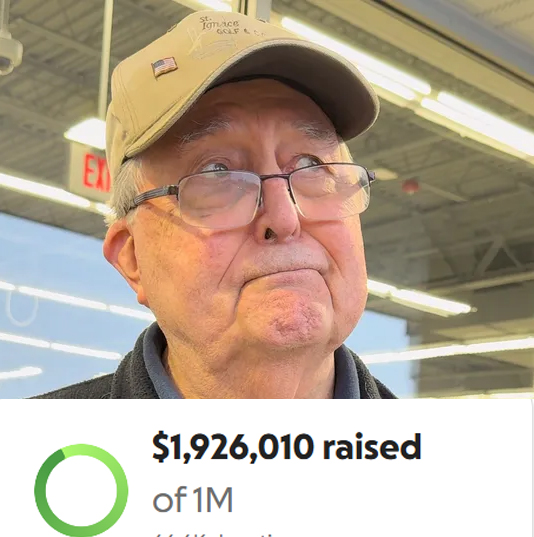
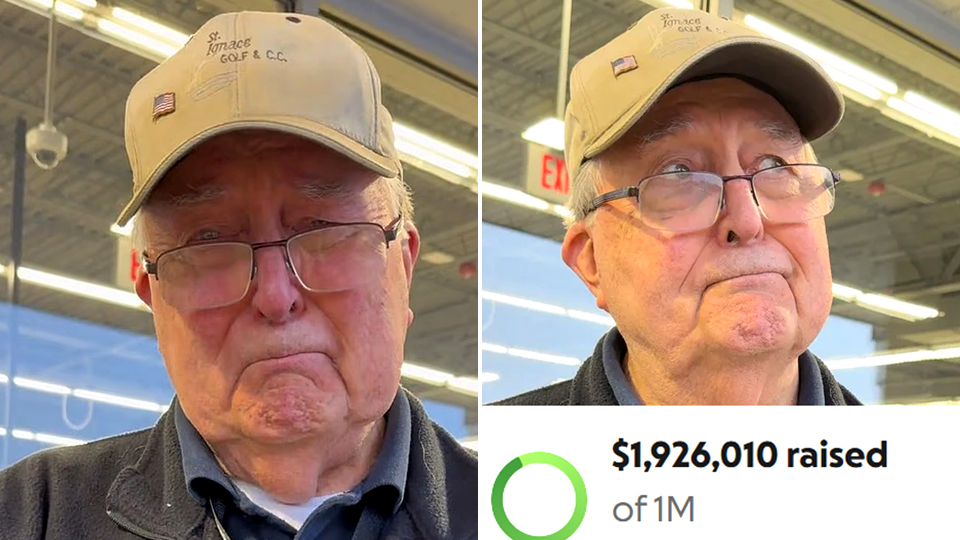
Within two days, the fundraiser passed one million dollars. Major donors joined in. The story reached people who had never met Ed but felt, in some genuine and immediate way, that they knew him, that they owed him something. What began as one conversation at a grocery checkout became a tidal wave of compassion.
When Samuel returned to the store to tell Ed the news, the old cashier blinked, stunned. “What do you mean… retire again?” he asked, as if the words did not belong to him anymore.
But they did.
Ed Bambas, at nearly ninety years old, was finally told he never had to stand behind a cash register again. He never had to choose between medicine and groceries. He could rest, truly rest, for the first time in decades.
“It feels like breathing again,” he said, hand pressed to his chest.
Stories like this do not fix the world. But for a moment, they remind us what people can do when someone shines a light on a quiet corner of someone’s life, how strangers can come together, lift a burden, and place a little hope back into a man’s hands.
And sometimes, that is more than enough to restore your faith in humanity.